There Is No Selling Out Anymore

Mar. 8th, 2026 05:42 pm
[syndicated profile] scalziwhatever_feed

Posted by John Scalzi

A couple of days ago the New York Times published an essay from writer Jordan Coley called “How Selling Out Made Me a Better Artist,” in which Coley discovers that all the less-than-amazing pay copy he’d written over the years, from marketing to puff-piece articles and everything in-between, actually made his creative and/or more serious journalism work better, not worse. The still-lingering debate of “art vs commerce” weighs heavily in the piece, as do issues of class and race (Coley is black and comes from a working class background, unlike many of his Yale University contemporaries), and how they both impact how one make’s one’s way in a creative trade.

I encourage you read to read the piece (the link above is a gift link so you can read it at your leisure). I don’t know Coley, or have read enough of his work to say anything about it one way or the other. But I certainly remember my freelance writing years (roughly from 1998 to 2010, when the novel gig finally become remunerative enough that it made sense to focus on it primarily), and my willingness not to be proud about how I was making money, because I had bills to pay and a family to support, and there was no financial support system for me to fall back on. My experience with freelancing certainly resonates with his.

In fact, if I do have any judgements to make against anyone in the “art vs commerce” debate, it’s with the sort of person who would look down on anyone who has to work for a living while also trying to write/create things of significance. One, of course, it’s an immensely privileged position to take, and one that is increasingly at odds with the reality of making a living in the writing field, or in the arts generally. It’s never been a great time to be a professional writer, ever, but these days the field is being aggressively hollowed out both from above (newspaper/magazine/Web sites laying off staff positions) and below (“AI” being used, usually poorly, for a gigs that writers used to do). Anyone who looks down their nose at someone else’s hustle to exist, can, genuinely, go fuck themselves. Short of writing hateful material, here in this capitalist hellscape, a gig is a gig.

Two, and as Coley points out in his essay, the experience of the hustle is in itself fertile ground for writing. It makes you develop a range of writing tools you can employ elsewhere, it puts you in situations that you would not have otherwise been and allows you to mine those experiences for later writing, and it makes you get out in the world and see it from the point of view of people who might not have come into your orbit and situation. That includes any day job, not just ones related to the arts. As a writer, and as a creator, nothing one ever does, professionally or personally, needs to be wasted. It’s all fuel for the creative engine.

With all that said, I think it’s important not to construct a strawman opponent, just to burn it down with self-satisfaction. Coley’s battle with “art vs commerce” was more about his own internal battle than it was against the opprobium of others. I have run across a few snobs in my time who seemed to look down at people who had to work for a living, but it’s only been a few. The vast majority of the creative folks I know are entirely comfortable with the idea that you have to pay bills, and sometimes that means doing less than 100% creatively fulfilling work in order to keep the proverbial roof over one’s head. Whether that has to do with me mostly working in genre literature, which has always been the domain of jobbing writers, is a question to be answered some other time.

The point is the internal discussion of “am I wasting my life paying bills when I should be making art” is these days as much if not more often the issue, than any external question about how one is spending one’s time. For myself, I tended to resolve this question as such: The fact of the matter is I am only really ever creative a few hours a day, three or four hours tops, and often less than that. So why not spend that creative downtime, you know, making money? Concurrent to this, the stuff that I was doing to make that money were frequently things I could bat out fast and with facility, enough so that often my train of thought was “I can’t believe how much I’m getting paid to do this.” I wasn’t cheating anyone or ever turning in bad product. It was just, you know, easy. I was delighted to make easy money! I would do it again!

Anyway: If you’re a writer or creator, never be ashamed of what else you do. It’s 2026 and this special flavor of gilded age we live in at the moment means that what qualifies as “selling out” has an extremely high bar. Making a living was very rarely “selling out” in any era. I think these days the phrase should be mostly reserved for writing things you absolutely don’t believe, for the sort of people you would in fact despise, with the result of your work is you making the world worse for everyone. Avoid doing that, please.

Short of that, get paid, have those experiences and develop new tools. All of it will be useful for the art you do care about. That’s not selling out. That’s learning, with compensation.

— JS

What If We Kissed Under the Chihuly

Mar. 8th, 2026 03:58 am
[syndicated profile] scalziwhatever_feed

Posted by John Scalzi

This particular one is found at the San Antonio Public Library, and it’s a doozy. They tell me it’s disassembled every couple of years in order to clean it. I could never do that job. I would break everything and have to live in shame for the rest of my days.

In other news, today’s Pop Madness convention at the library was lovely. Martha Wells and I had a full room for our conversation, and my signing line went on for a while (thank you to everyone who stuck it out). Plus I ate some absolutely amazing empanadas. It was a good day.

— JS

[syndicated profile] scalziwhatever_feed

Posted by John Scalzi

Inspiring view, isn’t it.

I’m here in San Antonio specifically to be part of the Pop Madness Convention at the San Antonio Public Library tomorrow, March 7. I’ll be there along with Martha Wells, Robert Jackson Bennett, John Picacio and other cool folks, being on panels and signing books and all that good stuff. If you’re in the San Antonio area tomorrow, come down and see us!

And if you’re not in the San Antonio area tomorrow, I mean, have a good Saturday anyway, I guess.

— JS

[syndicated profile] dinosaur_comics_feed
archive - contact - sexy exciting merchandise - search - about
March 6th, 2026next

March 6th, 2026: Last night I had chicken wings for dinner! Just wings - not even a vegetable! Not even a carrot stick or piece of celery, AND I'M STILL HERE (and a little hungry, it wasn't very many wings and I should eat better, but it was a sometimes treat.)

– Ryan

The Big Idea: Randee Dawn

Mar. 5th, 2026 09:21 pm
[syndicated profile] scalziwhatever_feed

Posted by Athena Scalzi

If everyone only wrote what they knew, how many books would we be deprived of? Author Randee Dawn has some concerns about the age-old advice, and suggests writers should get out of their comfort zone in the Big Idea for her newest novel, We Interrupt This Program.

RANDEE DAWN:

There are many phrases writers long to hear: Your book is a best-seller! Your book changed my life! Your book is getting a Netflix adaptation! Your book props open my screen door!

Maybe not that last one.

But if there’s one phrase writers are a little tired of hearing is this: Write what you know.

What does that even mean? For years, I thought it was reductionist and stupid. I write speculative fiction. Spec fic is about dragons or distant planets or zombies or dragons and zombies on distant planets. I have yet to encounter any of those things. But isn’t that what imagination is for? Make stuff up!

Write what you know is a rhetorical piece of advice that sends young writers off on the wrong path, and often confuses older ones. It explains why twenty-two year olds write memoirs. They don’t know anything but their own lives!

But it can have value. My first useful encounter with understanding write what you know came when I plumbed my entertainment journalism past – including time at a soap opera magazine – to write a goofy first novel, Tune in Tomorrow (helpfully given its own discussion in The Big Idea in 2022). I knew what backstage on TV and film sets looked like. I’d spoken to thousands of actors, producers, and directors. It wasn’t so far a leap to imagine how things might be different if magical creatures were running things. 

Then it came time to write the next story in the Tune-iverse. I’d used up a lot of Stuff I Knew. So what could come next to keep things interesting? 

That was when I discovered that the advice isn’t stupid. It’s just not the only advice that matters. Writing what you know can – pick your metaphor – give you a frame, a recipe, or a direction to follow.

But writing what hurts gives you substance. Writing what hurts gets you into the subcutaneous zone. 

With We Interrupt this Program (the next, also standalone, novel in my Tune-iverse), I tried to picture what the rest of the fae entertainment universe – run by the Seelie Court Network, of course – would look like. I imagined whole villages run by fae, populated by humans full-time, whose lives fit into neat little tropey stories. What if all the Hallmark movies were shot in the cutest, sweetest, village ever? What if there was a whole burg populated with humans who’d pissed the fae off and were being punished? What if a seaside town existed where a gray-haired older lady author solved cozy mysteries? 

The latter one gave me Winnie, an older woman whose cozy mysteries about her TROPE Town neighbors were turned into movies for SCN. But Seaview Haven is in trouble when we meet Winnie, and she discovers she’ll have to write a really good story to fix matters. So she writes about a love affair with the town’s Seelie Showrunner/Mayor/Director.

But those who vet it say it isn’t good enough. It’s nice. She wrote what she knew. Then she’s told to write what’s hard.

The novel took me by surprise here. I hadn’t planned to make her write two important stories. The love story should be enough. But it was only good. It wasn’t great. Despite being supernatural, it felt mundane. Tropey.

In going deeper to find Winnie a hard story, I discovered I already had one based on events in my real life. I gave them to her. Sure, it’s about love. But it’s also about betrayal and writerly jealousy, the kind delivered with a stiletto and not a butcher knife. Frankly, I’m a little embarrassed it’s in there. It’s not an epic awfulness. I didn’t commit a crime. 

Probably. 

And in giving it to Winnie, the story worked for me. When she unveils her personal, painful moment, it folds into the story as if I’d planned it. We Interrupt remains slapsticky, punny, and full of lunatic moments. Hopefully, though, that’s why this moment – the hurtful story – hits the hardest.

Readers can sense when we’ve gone deep, and when we skate the surface. A writer always has to find a way to squint at their latest creation and ask if they’ve gone deep enough to make it hurt, no matter what the genre is. That’s what – if I’ve done it right – it means to stick the landing.

So let’s look at that old hoary advice once more. Yes, write what you know. 

But don’t stop there. 

After you figure out what you know, figure out what’s hard. What hurts. Pull out the stiletto, not the butcher knife … and get cutting. 


We Interrupt This Program: Amazon|Barnes & Noble|Bookshop

Author socials: Website|Instagram|Facebook

[syndicated profile] scalziwhatever_feed

Posted by John Scalzi

We have an outline! Major characters, plot lines, and various important story beats all laid out. Now to start writing it all up. Very exciting stuff.

This is worth noting because this is the first time Athena and I are doing this, but it won’t be the last, since we’ll be using this process to develop other projects soon. This is what our little family business does, after all: Think of cool stuff that we can then develop into actual projects that will hopefully become things you can see and buy. This is, hopefully, the first of many.

— JS

The Big Idea: Lauren C. Teffeau

Mar. 4th, 2026 06:09 pm
[syndicated profile] scalziwhatever_feed

Posted by Athena Scalzi

Futuristic fiction doesn’t always have to be dystopian, and in fact author Lauren C. Teffau wanted to show readers a more hopeful narrative where people work together for the betterment of the planet and a goal of reaching a brighter future. Follow along in her Big Idea for Accelerated Growth Environment and see what a more optimistic future could look like.

LAUREN C. TEFFEAU:

We are living at the intersection of competing futures. Ones we thought were inevitable and others being forced down our throats by billionaires, technocrats, and foreign interests that are counter to our own. This fight over our collective future is happening while the climate crisis rages on, institutions are tested, and the informationsphere weaponized. It’s no longer a question of how to avoid the worst outcomes, but how bad those outcomes will be. 

But I firmly believe optimistic stories about the future are our way out of the doomloop. Not because they’ll accurately predict what is to come, but because they give us something to work toward, together. To that end, I wanted to explore what an international response to the climate crisis would look like in my latest book, the eco-thriller Accelerated Growth Environment, and introduce a generation of readers to one possible future full of cooperation, resilience, and competency porn. 

Such a goal is not completely out there. Once upon a time, the world came together to reduce ozone emissions in response to the discovery chlorofluorocarbons were punching a hole in the atmosphere. The effort was so successful, the ozone layer is on track to completely regenerate, according to Wikipedia, by 2045. That’s amazing, even moreso considering that level of international coordination seems impossible today. But maybe, just maybe, it’s something we can work toward in the years to come. 

So imagine things change, and the political will is finally ascendant to tackle the climate crisis. Enter the Climasphere, a groundbreaking megastructure that can support nearly every biome on Earth and grow plants essential to rewilding efforts across the world, signifying a new era of climate cooperation. It’s also the high-tech setting for Accelerated Growth Environment. Principal Scientist Dr. Jorna Beckham just wants to focus on her research while her horticulture techs are on break following the grueling inaugural harvest.

She manages the habitat with the help of her trusty robot sidekick Savvy while Commander Kaysar sees to everything else. But when an explosion rocks the Climasphere, Jorna is the commander’s number one suspect. Her family belongs to a technology-adverse religion that believes the Climasphere’s genetically-altered plants are a rejection of God’s gifts to humanity. Jorna must clear her name if she wants to keep her dream job and any possibility of a future with the commander.

I’m honored Accelerated Growth Environment is the first acquisition and release from Shiraki Press, a new publisher specializing in hopepunk stories for a brighter future. Keep an eye out for more titles from them in the months to come. 

And never forget we are capable of great things—we need to be. No matter all that has happened this year as we grapple with betrayals of the past and the predatory power grabs of the present, we must remember all the amazing things we can do in preparation of the future we will build together.


Accelerated Growth Environment: Amazon|Barnes & Noble|Bookshop|Shiraki Press 

Author Socials: Website|Instagram|Bluesky|Linktree  

Indefinite Book Club Hiatus

Mar. 4th, 2026 03:21 am
[syndicated profile] scalziwhatever_feed

Posted by John Scalzi

Today in “Things that ‘AI’ has ruined”:

No, I won’t be able to show up to your book club’s online/offline gathering, and the reason for this is simple: I, and likely every other author you might care to name, am so inundated with “book club” spam that it’s become impractical and often impossible to suss out the solicitations by actual book clubs with actual humans, from the literally dozens of “AI”-generated spam book club emails I get daily. I don’t have the time to attempt to sort the real ones from the fake ones, or to go through the multiple emails that might be required to assure myself that there’s not a money ask somewhere in there. Plus there’s the additional risk that if you respond to even one spam email, your name is added to the a list of potential suckers which is then itself offered up to other spamsters, thus continuing the cycle of bullshit.

Bluntly, I can spend my days sorting “book club” spam, or I can write books. One pays me money. The other does not. So until further notice, I’m not entertaining book club invitations from anyone, and I likely won’t respond to your invitation at all. I’m sorry but this is the reality of the moment.

To be clear, it’s not just your book club that’s being ruined by this crap. It’s also become exponentially more difficult to suss out legitimate convention/book festival invitations and paid speaking gigs from a sea of “AI”-generated asks that ultimately try to scam money from me and other authors (and from any other person who might even attend a convention or conference; writers aren’t special to scammers). I am fortunate to have actual publicists and a speaking bureau that act as filters for me (plus I have a working knowledge of actual conventions, at least here in the US), but a lot of writers don’t have that, and it’s become an actual stressor for a lot of them to sort the real stuff from the fake stuff. It also makes it harder for them (and other creatives) to effectively market themselves to actual humans who might actually read, and pay for, their work. It sucks for us all, some of us more than others.

If you’re a scammer who uses “AI” to try to defraud actual humans, please die in a fucking fire, thanks. For everyone else, sorry a flood of spam has ruined book clubs. It’s awful for every one of us.

— JS

The Big Idea: Kirsten Kaschock

Mar. 3rd, 2026 05:45 pm
[syndicated profile] scalziwhatever_feed

Posted by Athena Scalzi

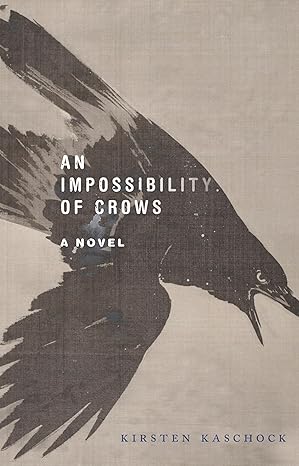
Does a mad scientist do what they do out of sheer love of the game, or because they can’t just up and quit doing the whole mad science thing? Do they love their work, or is it just unhealthy obsession? Author Kirsten Kaschock looks at some of fiction’s most well-known inventors in the Big Idea for her newest novel, An Impossibility of Crows, drawing parallels between herself, her main character, and all the truly mad creators of the past.

KIRSTEN KASCHOCK:

A crow the size of a horse.

The dream terrified me but not the way you’d think. I was drawn in. A little hypnotized. Even in the dream I wanted to understand how the thing came into being. And, in the dream, the crow wasn’t threatening me—just doing crow things.

The crow kept coming back, not at night, but in my wandering mind or whenever I saw an actual crow. I’d look at one walking in the snow or huddled in a tree and think to myself, “What if?” That’s when I started sketching the crow’s maker: Agnes Krahn. 

I needed to know who would decide to build (I often call it building rather than breeding for reasons I can’t quite explain) a crow of such size and why? To figure that out, I started writing as if I were Agnes—a scientist, of course—commenting on her world in real time. The book had to be a diary. But because she was a scientist, an ex-chemist to be exact, Agnes also included her research in these pages. And then, other odds and ends kept arriving, including letters from Agnes’s long dead mother. It wasn’t until that moment that I realized that the book would be so closely linked to Mary Shelley’s Frankenstein—which is also epistolary and multivocal. But there was already a marked difference. Agnes, unlike Victor Frankenstein, is a woman.

How many other unhinged women scientists have found their way into literature? Fewer, I’d wager than their male counterparts. I imagined Agnes’s reasons for building Solo (the crow’s name is Solo) to be different than most of the mad scientists’ I have read, and more like Mary Shelley’s own backstory: never knowing her own mother, her loss of a child, a need to prove herself to the poets among which she found herself. 

I knew Agnes wasn’t driven by ego or ambition, exactly. She isn’t selfless either. God no. But her obsession with increasing the size of the bird has a reason other than narcissism: she wants to provide her daughter with wings.

This is where Agnes and the character of Victor F. part ways. When I realized why Agnes was building Solo, she started to resemble other creators from other stories. 

Agnes wants to give her daughter this crow, but what her daughter thinks or feels about this is irrelevant. Agnes is trying to provide an escape route for someone who—I learned while writing her—does not feel particularly trapped. But Agnes is oblivious to how her daughter perceives herself. In this way, Agnes is as monstrous as most mothers. 

The model I used for their relationship is actually that of a father and son—Daedalus and Icarus. I’ve long loved this Greek myth, although it was taught to me as a tragedy of disobedience: warned about the dangers of flight, Icarus cannot help but fly too close to the sun. But what if the fault lies with Daedalus, who should have known his child better? In my novel, Agnes does not know her daughter at all. This is both their tragedy and another mystery I had to solve: Why doesn’t she? Writing a Gothic Horror novel turned into a bit of a rabbit hole… a Russian doll. The book kept asking me why things are the way they are. Why people do the things they do. And at the bottom of every version of Agnes I found another woman, another layer of hurt.

To be honest, this is why I write in the first place. To get to the under-questions, the ones below the surfaces of thought.

Solo, the crow, is in some ways a cipher: a darkness onto which I was reading human nature. But Solo is also very real. He is an immense crow, with all the intelligence of a crow (maybe more), and thus he is horrifying in his own right. That’s how we read each other, too. We know people as what they are to us, and only if we are incredibly lucky and attentive do we ever learn who they are beyond our needs, fears, and desires of them.

Agnes is the only one in the book who doesn’t see Solo as an existential threat, or not until it is too late. She may not admit it to herself, but as she builds him—he grows into a replacement for her daughter rather than a gift to her. She is Mary Shelley. She is Victor Frankenstein. She is Daedalus. And she is Gepetto. As she gets more and more drawn into her experiment, her attention to her family wanes and her devotion to the crow increases. I, myself, am married to a scientist. I am an artist. We have both done this with our work. We do this. Agnes is also him. And she is me.

Her madness I am familiar with: Agnes wants to create a life larger than her own. Somehow, she believes that Solo can free her from her guilt and grief. 

The big idea in An Impossibility of Crows is this: when you bury your feelings they don’t stay dead—and when they rise up, they may find a form beyond any you can hope to control. I began writing with a single frightening image. I moved quickly from there to considering the crow’s creator. Then, in seeking to understand Agnes, I progressed through a series of models towards my own reasons for making. 

I had a teacher once who said that writers only write about three things: sex, death, and writing. And then there’s this old joke: if it’s not one thing, it’s your mother. I think many things can be true at once. Nothing is ever Solo. And everything is. 

—-

An Impossibility of Crows: Amazon|Barnes & Noble|Bookshop

Author socials: Website|Instagram|Facebook

New Cover: “Valley Winter Song”

Mar. 2nd, 2026 07:48 pm
[syndicated profile] scalziwhatever_feed

Posted by John Scalzi

I woke up this morning and there was a whole new blanket of snow on the ground. Which I don’t love! Here in March! But I guess it is still technically winter for another three weeks, and also, it made this particular cover song I was working on more appropriate. The original is from Fountains of Wayne, which is best known for “Stacy’s Mom,” although songs like this one are rather more in line with the songwriting typical of the group. This is one of my favorites, and a little bit of a deep cut. But deep cuts can be good sometimes. Enjoy.

— JS

[syndicated profile] scalziwhatever_feed

Posted by Athena Scalzi

I used to eat sunflower seeds when I played softball as a kid, and I can’t say I’ve ever eaten them since. For some reason, I was getting advertisements for Smackin’ Sunflower Seeds on Instagram. In that moment, I thought, you know what, sunflower seeds sound kind of good to snack on right now.

I would say in my life I’ve only had regular sunflower seeds, ranch, and BBQ flavored, so when I saw Smackin’s array of flavors, I was certainly intrigued. I am someone who believes variety is the spice of life, so of course I couldn’t choose just one flavor. I went ahead and bought a variety pack that included all their flavors (except the OG Original), and my dad and I gave them all a try.

I let my dad pick the first flavor we tried, and he chose “lemon pepper.” These definitely had a strong flavor, as advertised, and the taste actually reminded me a lot of a steakhouse. The peppery-ness wasn’t overwhelming, and my dad and I gave these ones a 6.5/10.

Up next, we went for a classic: Ranch. The ranch flavor reminded me a lot of a Hidden Valley Ranch seasoning packet, like the kind you mix into dips or salad dressings. Surprisingly, the ranch flavor was very subtle, which is certainly something that ranch never is. You get a Cool Ranch Dorito and that shit is RANCHED UP. In the case of these seeds, I could’ve used more ranch flavor. They were kind of weak, but the flavor that was present was good. These were a 6/10 from both of us.

We switched to a sweet flavor, their Cinnamon Churro. This flavor was actually really nice, it wasn’t just straight cinnamon, it had that nice churro-vanilla sort of flavor. I will say that the flavor wasn’t very long lasting, though. Like it wore off very quickly. The taste, while it lasted, was very nice and not too sweet, with just a little bit of saltiness to have a nice sweet-and-salty factor. This was a 7.5/10 from my dad and a 7/10 from me.

My dad wanted to get the Cheddar Jalapeno out of the way, since he feared it would be really hot and we’re not exactly known for loving spicy stuff. I’m happy to report that while these ones do have a real kick with a heat that lingers just a touch, it has a really nice actual jalapeno flavor and isn’t just hot to be hot. While there’s not so much of the cheddar flavor present, if you’re someone who likes a little bite in their snack, this one would be a great pick for you. I wouldn’t eat a whole bag, but they were pretty tasty. These were a 7/10 from both of us.

Onto Dill Pickle, which was one I was very excited for. Lemme just say, these bad boys were picklelicious. These had a super solid, bold pickle flavor that was very enjoyable and not too acidic, just had that nice dilly briny taste. These ended up being in my top two favorites overall, and we both gave them an 8.5/10.

Over to the Cracked Pepper, I was curious how this would compare to the Lemon Pepper. If you are someone who puts so much pepper on their steak or eggs that people around you are sneezing to high heaven, then this is the flavor for you. These were so peppery, like pretty overwhelmingly so. I honestly didn’t care for them, and gave them a 4/10, but my dad gave them a 6/10.

Next up was the Backyard BBQ. I do love barbecue chips, so I was looking forward to see how these compared flavor-wise. The BBQ was super bold! Just one seed was absolutely packed with BBQ flavor, and it was very tasty! More long-lasting flavor and very strong, these were super good and ended up being another favorite. My dad gave them an 8/10 and I gave them an 8.5/10.

Back to the sweet ones, we tried the Maple Brown Sugar. Like the Cinnamon Churro, they were really nice but not long-lived. They’re a bit subtle, like not a huge amount of maple flavor or anything, but still pretty good. My dad gave them a 7/10 and I went with a 6.5/10. The rating would be a lot higher if the flavor lasted longer or was stronger.

Starting to wrap up our sunflower adventure, Sour Cream and Onion was next. These tasted so classic and recognizable, like if you enjoy sour cream and onion chips, these are for you because they taste absolutely spot on. They honestly reminded me a lot of Philadelphia Cream Cheese Chive and Onion flavor. These were a 7.5/10 from both of us.

The final flavor before trying the mystery flavor was Garlic Parmesan. These were super garlicky, but didn’t offer up a whole lot of parmesan flavor. The garlic really stole the spotlight here, but it was still a tasty flavor, earning it a 7/10 from both of us.

Finally, the mystery flavor! I truly had no idea what to expect. Do you know how DumDums make their mystery flavors? Well, I can only assume that Smackin’ does the same thing, because the mystery flavor tasted exactly like the Cheddar Jalapeno and Ranch mixed together. It was like the Cheddar Jalapeno but less hot, and somehow even better! The mystery flavor earned an 8/10 from both of us.

Well, there you have it! Eleven flavors of sunflower seeds. The only one I didn’t get to try that I would’ve loved to is Cheeseburger! Honestly, these were pretty solid sunflower seeds. It felt kind of nostalgic to eat them, even if they are kind of tedious to get through. I felt like one of those dogs that has a “slow down” bowl because you can’t just plow through them like chips or crackers.

Anyways, if you’re interested in trying some for yourself, I have a 10% off code for you! Yippee!

Which flavor sounds the best to you? Do you eat sunflower seeds often? Let me know in the comments, and have a great day!

-AMS

Profile

asri: Photo of myself (Default)
Jonas

September 2023

S M T W T F S
     12
3456789
1011121314 1516
17181920212223
24252627282930

Most Popular Tags

Style Credit

Expand Cut Tags

No cut tags
Page generated Mar. 9th, 2026 07:24 am
Powered by Dreamwidth Studios